Summary
The US Environmental Protection Agency (EPA) regulations
released on March 20, 2024, seem designed to drive toward a BEV
solution, though the agency does describe the rule as “technology
agnostic,” several elements seem fundamentally designed to
encourage the battery electric vehicle solution for zero-emissions
vehicles.
- Light-duty CO2 regulations still have a similar end
point for the 2032 model year. Requirements for model years
2027-2030 are easier than the agency proposed in April 2023 and
still tougher than previous rules. - Tier 4 regulation of particulate matter and other critical
emissions (NOx, etc) have strict end target, also eased from the
April 2023 proposal and are more strict in 2031 and 2032. To meet
these requirements, it is our assessment that essentially any
vehicle with an engine–hybrid and PHEV included–will require a
particulate filter to capture particulate matter and be compliant
by 2032 model year. - The Department of Energy has also updated the calculation for
determining the eMPG equivalent for battery electric vehicles. The
revision was largely designed to ensure BEVs contribute less in
eMPG. This change will affect NHTSA calculations for fuel economy
compliance rather than GHG emissions. It will make it harder to use
minimal BEV sales to offset ICE vehicle sales, further encouraging
sales of BEVs. - The EPA has maintained the averaging, banking and trading of
credits, as well as the carry-forward and carry-backward
provisions; the April 2023 proposal had not recommended any
change. - In terms of off-cycle credits and credit menu items, it was
finalized that BEVs do not get credits for items that reduce fuel
consumption but are not captured in the fuel-efficiency or
emissions test cycles. This was expected; as a BEV does not burn
gasoline or diesel fuel to operate, allowing a BEV to get the
credit could create a situation where a BEV had a negative GHG
compliance value. Off-cycle credits are available only to vehicles
with tailpipe emissions greater than zero. - The EPA maintains the footprint-based structure, grouping
vehicles and expected emissions by size, though the calculations
have been adjusted to reduce the likelihood for manufacturers to
change the size or regulatory class of vehicles as a compliance
strategy.
New regulations well received
The final ruling has, in general, been well-received by the
industry. As noted, it allows for a more gradual ramp-up in BEV
compared to the previous base proposal. However, the more gradual
ramp also means that in the last two model years, the requirements
have a steeper drop. Automakers will need to work toward a more
aggressive catch-up in the last two model years.
GHG / CO2 implications
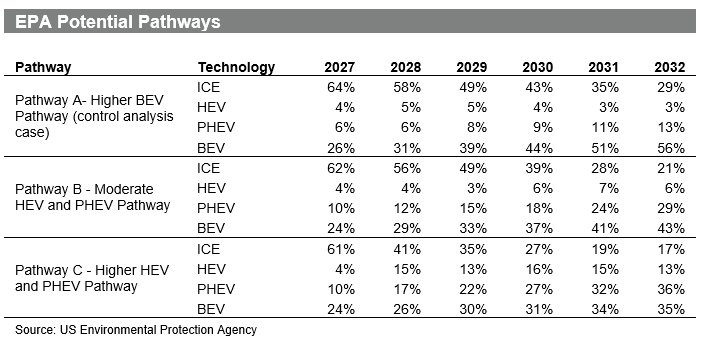
The EPA does not mandate what propulsion system is used, though
they do estimate what mix of battery electric, plug-in hybrid
electric, hybrid electric, or internal combustion engines could
meet the target, based on EPA calculations. With the final ruling,
the EPA illustrated three primary pathways to reach compliance,
demonstrating what kind of mix an automaker might use to reach
compliance. These EPA pathways are not directives, and automakers
can use a different mix to be compliant, but the pathways presented
provide some insight into possibilities.
Under EPA's three potential pathways, the estimated BEV rate to
reach compliance varies significantly. Pathway A sees EVs as high
as 26% in 2027 model year as one way forward to meeting compliance.
Each pathway considers a different mix of full hybrid and plug-in
hybrid solutions working with BEV solutions. We found it
interesting that the pathway scenarios which the EPA illustrated
each incorporated a heavier PHEV penetration than the proposal. In
these EPA illustrations, an assumption is made to see HEV at
roughly half the 8.6% share it had in January 2024 (according to
S&P Global Mobility light-vehicle registrations) in 2027 model
year. These illustrative pathways also have PHEV at more than three
times penetration in January 2024 (2.5%) as soon as 2027 model
year. These are simply illustrations of what the market might look
like but are likely indicative of what the EPA expects could be
viable. Another element of differentiation for these final rules
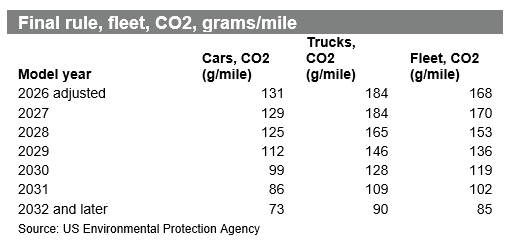
versus previous rules is that light-duty trucks, which includes
most utility vehicles, are challenged to reduce emissions by 51%
while passenger cars are expected to see a 44% decline in
emissions.
The three pathways that the EPA presented put the US market at
between 35% and 56% BEV sales in 2032 model year. This is also a
significant change from the April 2023 proposal which could have
put BEV penetration in 2032 at 67% of the US light-vehicle market.
These pathway illustrations also work to demonstrate it might still
be done even if the US market does not reach the 50% BEV sales
which President Joe Biden has set as a soft target for 2030
calendar year, while also suggesting that the EPA sees PHEV as the
more viable interim solution than its prior analysis suggested.
That change could see Stellantis adjust its plans for PHEVs within
its new multi-energy platforms, while Mercedes-Benz and BMW offer
PHEVs and may have the opportunity to adjust the mix as well.
Hyundai Motor Group also may be in a position to further refine its
PHEV technology and place more importance there. Toyota has so far
put more effort behind HEV, though it does also have robust PHEV
technology it could place more emphasis on. Lastly, this could mean
Ford and GM take a closer look at PHEVs as a solution to reach
compliance if BEVs don't take off as rapidly as planned.
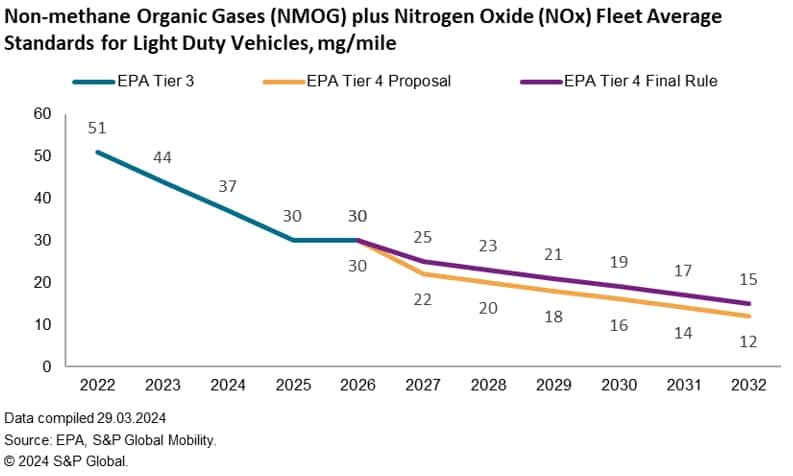
Tier 4: Non-methane organic gases (NMOG) and nitrogen
oxide (NOx) standards
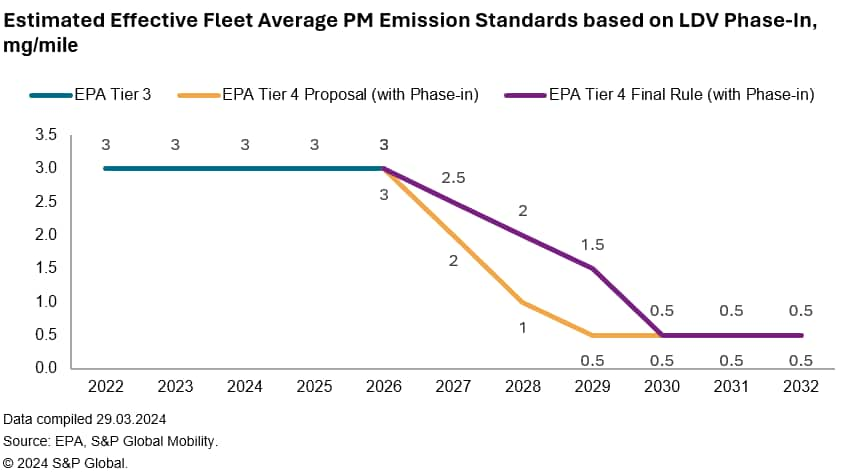
The regulations also address particulate matter and other
criteria pollutant emissions in non-methane organic gases (NMOG)
and nitrogen oxide (NOx), which are emissions from all
internal-combustion engines. These standards must be met by
multi-fueled vehicles as well, on each fuel which is used. Here,
too, the final rule is less onerous than the proposed rule, though
still requires a 50% reduction in these emissions.
With the final ruling, the industry request for PHEVs to receive
an adjustment because they can run on electricity only was
declined. These standards are required to be met by multi-fueled
vehicles on each fuel that is “consumed.” For PHEVs, that means
that the standards need to be achieved both on electricity alone
(charge-depleting operation) and gasoline (charge-sustaining
operation). As a result, we expect that PHEVs would not be exempt
from meeting these regulations and are likely to also need to
include particulate filters. The pressure here has the potential to
make PHEVs a more expensive solution than a BEV, in some cases.
Department of Energy Petroleum-Equivalency
Factor
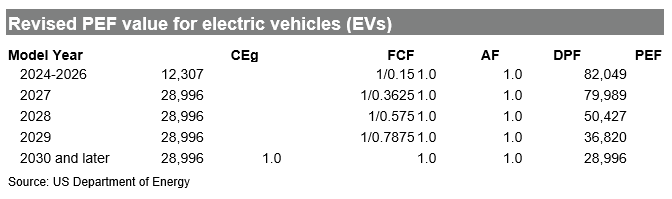
The US Department of Energy (DoE) has issued its final ruling on
updating the Petroleum-Equivalent Factor (PEF). This factor is used
in the EPA and National Highway Traffic Safety Administration
(NHTSA) calculation for determining the impact of EVs on a
light-duty automakers compliance with the Corporate Average Fuel
Economy (CAFE) standards. This factor essentially determines the
extent to which the sale of an EV may offset sales of internal
combustion engine vehicles. Vehicles with high eMPG contribute to
an automaker's compliance with CAFE standards, administered by
NHTSA and aligned with the EPA emissions standards. By reducing the
eMPG an automaker can claim for a BEV, it means the automaker
cannot use that high eMPG vehicle to functionally offset a low MPG
vehicle which is out of compliance. The final rule has been
positioned as a win for automakers because it reduces the PEF EV
fuel economy rating by 65% beginning in 2030, instead of a 72%
reduction starting in 2027 model year, as originally proposed; this
could give automakers more time to adjust to the change. However,
as with the other regulatory elements announced this week, this
change introduces further pressure on automakers to shift to
battery electric vehicles as a zero-emissions solution by reducing
the ability of BEV to offset multiple ICE sales. The win is in that
the factor does not go down as fast as earlier proposed and enables
a slightly slower walk to the 2032 targets.
S&P Global Mobility Initial Outlook
Our current February 2024 forecast already factors in a
regulatory environment expectation that was less aggressive than
the EPA's base proposal from last April. Therefore, it's premature
to note if any material powertrain changes will need to be
incorporated. Future forecast rounds will be updated to reflect any
necessary changes, particularly at a vehicle level.
The final rule has a similar endpoint to the proposed rule,
though the 2027 to 2030 model years are less stringent than the
EPA's base proposal from April 2023. This has, in general, been
well received by industry. The final rule allows for a more gradual
ramp up in BEV compared to the previous base proposal. This will
allow more time for consumers to adapt to the technology,
infrastructure to expand, and efficiency improvements in the legacy
ICE powertrain solutions. This is welcome news to S&P Global,
as our powertrain forecast had presumed a less aggressive EPA
regulation, owing to OEM/dealer/union pushback against the EPA base
proposal from April 2023.
Get a free trial of
AutoIntelligence
Commercials Cooperation Advertisements:
(1) IT Teacher IT Freelance

立刻註冊及報名電腦補習課程吧!
电子计算机 -教育 -IT 電腦班” ( IT電腦補習 ) 提供一個方便的电子计算机 教育平台, 為大家配對信息技术, 電腦 老師, IT freelance 和 programming expert. 讓大家方便地就能找到合適的電腦補習, 電腦班, 家教, 私人老師.
We are a education and information platform which you can find a IT private tutorial teacher or freelance.
Also we provide different information about information technology, Computer, programming, mobile, Android, apple, game, movie, anime, animation…
(2) ITSec

www.ITSeceu.uk
Secure Your Computers from Cyber Threats and mitigate risks with professional services to defend Hackers.
ITSec provide IT Security and Compliance Services, including IT Compliance Services, Risk Assessment, IT Audit, Security Assessment and Audit, ISO 27001 Consulting and Certification, GDPR Compliance Services, Privacy Impact Assessment (PIA), Penetration test, Ethical Hacking, Vulnerabilities scan, IT Consulting, Data Privacy Consulting, Data Protection Services, Information Security Consulting, Cyber Security Consulting, Network Security Audit, Security Awareness Training.
Contact us right away.
Email (Prefer using email to contact us):
SalesExecutive@ITSec.vip