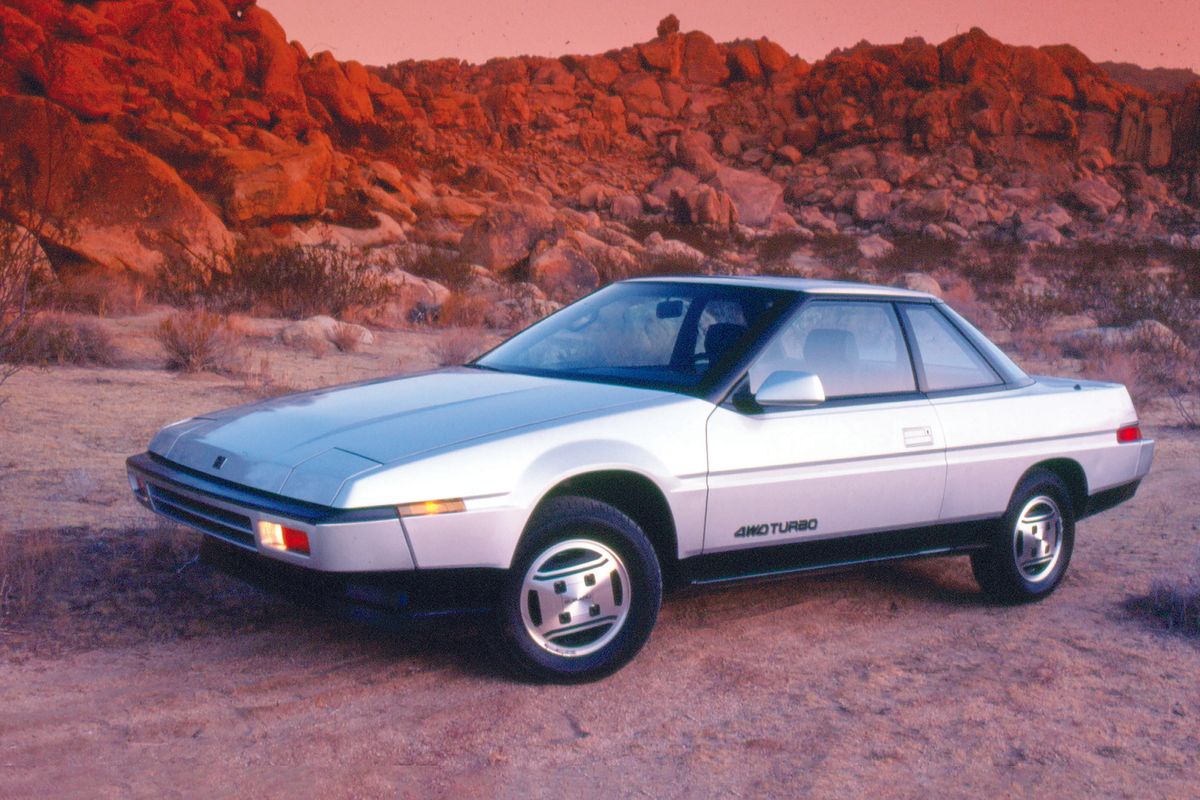
In the mid-1970s, Subaru enjoyed an enviable reputation as a builder of solid, reliable, economical compact cars set apart from all the rest by the availability of all-wheel drive. “Inexpensive, and built to stay that way,” was the company’s promise, and it was a promise kept by tough, simple cars like the DL and GL sedans, coupes, and wagons.
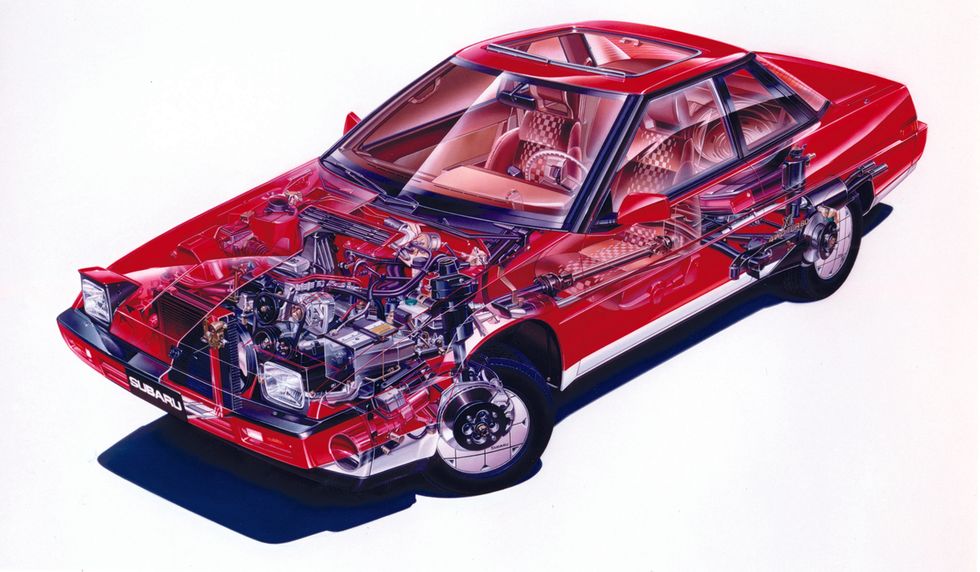
As the ’80s dawned, Subaru began looking at a move upmarket, especially in the lucrative U.S. market. Certain that a sporty flagship would draw buyers into showrooms, Subaru of America convinced the home office to build a car designed for the U.S. The result was the XT of 1985, a two-plus-two sports coupe with dream-car styling inside and out.
The XT was offered as four models: DL, GL, GL-10 Turbo, and GL-10 Turbo-Traction. Turbo models came with all the advanced gizmos and doodads that would fit, including self-leveling pneumatic suspension, a digital dashboard, a computer-controlled automatic transmission, and one of the industry’s first electro-hydraulic steering systems. Power for the DL and GL was from the same 1.8-liter, OHC flat-four the powered the sedans, in turbocharged form for the GL-10s.
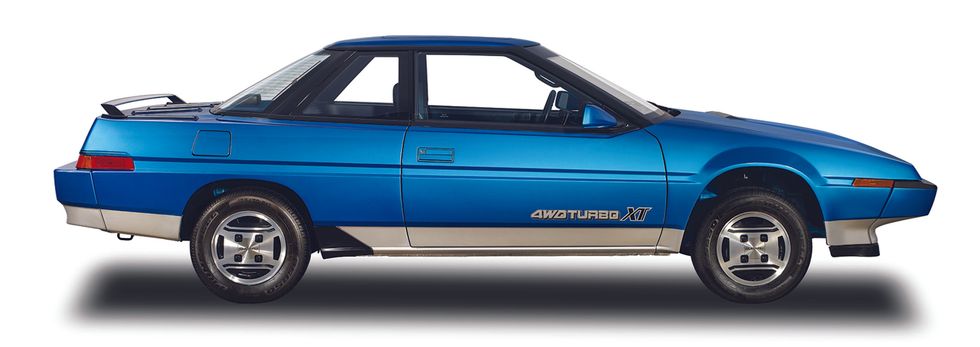
Photo courtesy of Subaru of America
For all their sophistication, the XT and XT Turbo always seemed to be less than the sum of their parts. Testers found that the handling was so-so, the wedgy styling was odd at best, the digital gauges were baffling, and the 1.8-liter turbo four was underwhelming. “The engine has all the right stuff—turbocharging, fuel injection, overhead cams—but it ought to make quite a bit more power than it does. And it thrums when you press it to the redline,” wrote Car and Driver’s Rich Ceppos. At least it was better than the normally aspirated four, which “howls like a riding mower when you lead-foot it.”
For 1988, Subaru performed a hard reset of its flagship coupe, taking a step back toward orthodoxy. Out was the XT Turbo; in was the XT6, which addressed the previous car’s shortcomings, beginning with its powerplant.
Replacing the 1.8-liter four was a 2.7-liter flat-six, Subaru’s first. Codenamed the ER27, it shared pistons, connecting rods, and bore spacing with the 1.8, saving some manufacturing costs, and boasted a revised fuel-injection system that helped it produce a respectable 145 hp—30 more than the turbo, and a whopping 48 more than the unboosted four. Two different all-wheel-drive systems were offered; cars with the four-speed automatic used a computer-controlled, hydraulic multiplate clutch to vary the amount of power transmitted to the rear wheels, while those with the five-speed manual employed a lockable center differential to split torque equally between the front and rear axles.
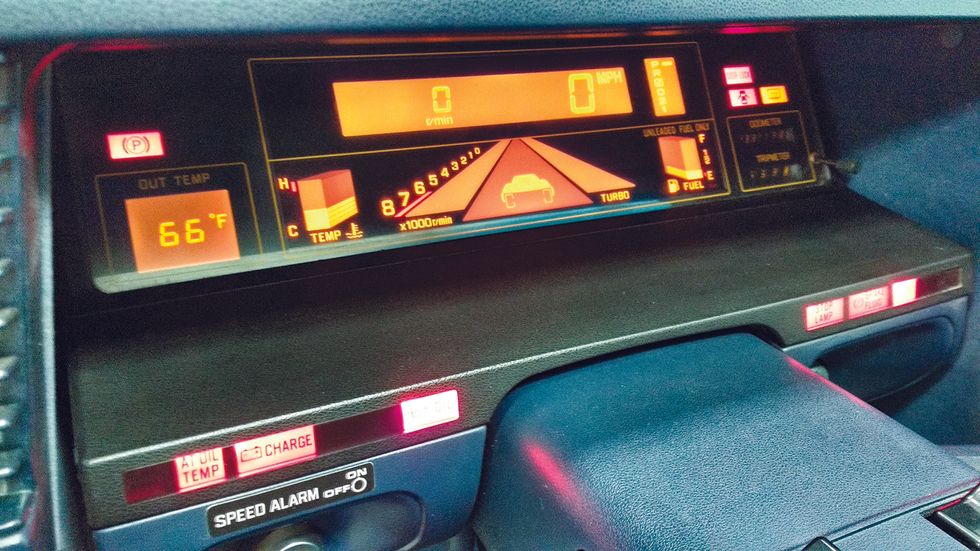
Photo courtesy of Subaru of America
The underpinnings got a going-over, too. The self-leveling air suspension, standard on 4WD cars, was recalibrated, and all XT6s benefitted from beefier anti-roll bars, bigger brake discs, wider wheels, and meatier tires. Inside, the Close Encounters of the Third Kind digital gauge package was dropped in favor of big, easy-to-read analog dials, though the asymmetrical steering wheel and gimmicky control pods on either side of the gauges remained.
It was an all-around better car—Car and Driver called it “undoubtedly the best Subaru ever built”—but Subaru still had a couple of hurdles to overcome. One was price: The front-wheel-drive XT6 started at $16,116, rising to $16,956 for an all-wheel-drive manual and $17,716 for the automatic version. Even though the cars came fully equipped with air conditioning and other features, it was still a big price tag, especially for a car from a company that had made its name building cars for the budget conscious. The other problem was that the XT6 lacked a market identity. Was it a sports car? Sports coupe? GT? Most often it wore the label “sporty two-plus-two for those who need all-wheel-drive,” which was a pretty narrow segment. For the same monthly payment, a buyer could have a Mazda RX-7 GTU; stretching the budget a bit would put a new Porsche 924S in the garage.
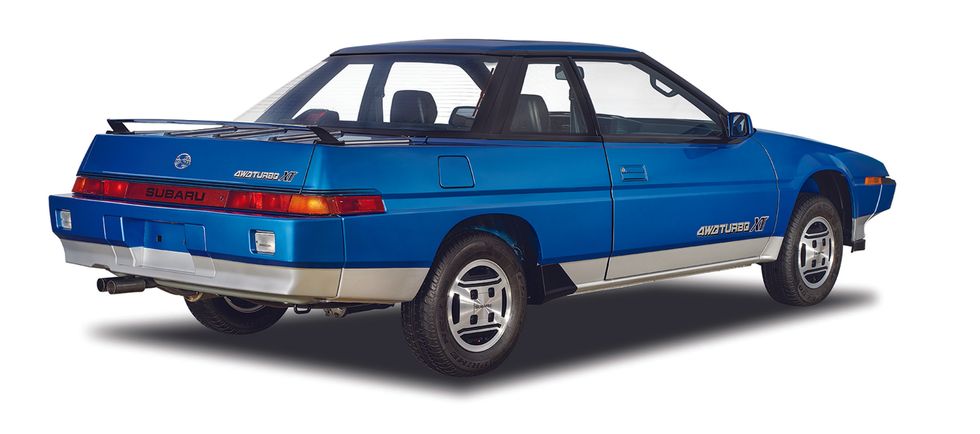
Photo courtesy of Subaru of America
The XT6 stayed in the catalog until 1991, when the equally unorthodox SVX was launched into the same market. Worldwide sales of all XTs amounted to just under 100,000. By comparison, sales of Honda’s third-generation Preludes were 60 percent higher, with three fewer years of production.
Sales listings for XTs and XT6s seem to be few and far between. Classic.com lists just three sales at auction since 2017: two XT GLs that sold for $17,500 and $5,200, and an XT6 that brought $5,700.
Specifications – 1985-1991 Subaru XT and XT6
Engines
- 4 cylinder: OHC horizontally-opposed 4-cyl., 1,781 cc (109-cu.in.); 97 hp @ 5,200 rpm; 103 lb-ft @ 3,200 rpm
- 4 cylinder turbo: Turbocharged OHC horizontally-opposed 4-cyl., 1,781 cc (109-cu.in.); 111 hp @ 4,800 rpm; 134 lb-ft @ 2,800 RPM
- 6 Cylinder: OHC horizontally-opposed six-cylinder, 2,672 cc (163.1-cu.in.); 145 hp @ 5,200 rpm; 156 lb-ft @ 4,000 rpm
Transmission
- Five-speed manual or four-speed automatic
Suspension
- Front: MacPherson struts with lower arms, anti-sway bar, self-leveling electronic air suspension (optional)
- Rear: Semi-trailing arms, anti-sway bar, self-leveling electronic air suspension (optional)
Brakes
- Four-wheel disc
Wheelbase
- 97.1 inches
Curb Weight
- 2,612 to 2,886 pounds
Price new
- $16,116-$17,716
Value today
- $4,700
Commercials Cooperation Advertisements:
(1) IT Teacher IT Freelance

立刻註冊及報名電腦補習課程吧!
电子计算机 -教育 -IT 電腦班” ( IT電腦補習 ) 提供一個方便的电子计算机 教育平台, 為大家配對信息技术, 電腦 老師, IT freelance 和 programming expert. 讓大家方便地就能找到合適的電腦補習, 電腦班, 家教, 私人老師.
We are a education and information platform which you can find a IT private tutorial teacher or freelance.
Also we provide different information about information technology, Computer, programming, mobile, Android, apple, game, movie, anime, animation…
(2) ITSec

www.ITSeceu.uk
Secure Your Computers from Cyber Threats and mitigate risks with professional services to defend Hackers.
ITSec provide IT Security and Compliance Services, including IT Compliance Services, Risk Assessment, IT Audit, Security Assessment and Audit, ISO 27001 Consulting and Certification, GDPR Compliance Services, Privacy Impact Assessment (PIA), Penetration test, Ethical Hacking, Vulnerabilities scan, IT Consulting, Data Privacy Consulting, Data Protection Services, Information Security Consulting, Cyber Security Consulting, Network Security Audit, Security Awareness Training.
Contact us right away.
Email (Prefer using email to contact us):
SalesExecutive@ITSec.vip