The openness of international markets, amplified by the
acceleration in globalization over the past few decades, is usurped
by the creeping return of protectionism. Nothing illustrates this
trend better than the ongoing tug of war over electric vehicles
(EVs) and their related supply chains. Policymakers in the US and
European Union are rattled by the ambitions of mainland Chinese
companies to expand exports of low-cost EV and EV parts, forcing
them to announce new policies and reconsider import tariffs.
In this regard, the US announced some changes in tariffs this
month to thwart imports from mainland China. The new tariffs target
imports of EVs, lithium-ion batteries, and critical minerals such
as graphite and permanent magnets from mainland China. According to
the official announcement, in 2024, the tariff on EVs imported from
mainland China will increase from 25% to 100%, the tariff on
lithium-ion EV batteries will increase from 7.5% to 25%, and the
tariff on battery parts will increase from 7.5% to 25%. The new
tariffs will take effect on Aug. 1, 2024, the US Trade
Representative's office said on May 22. The tariff on natural
graphite and permanent magnets will be increased from 0% to 25%,
but not until 2026.
What's the rationale behind the hikes?
The Biden administration reckons that the new measures were
necessary to prevent mainland Chinese companies from flooding the
US market with cheaper EVs and batteries, which would make it
difficult for American companies to compete. According to a
statement released by the White House, the current US government
has attracted billions of dollars of investments for the
development of a reliable EV supply chain, including batteries and
critical mineral, through tax credits under policies such as the
Inflation Reduction Act (IRA) and the Bipartisan Infrastructure Law
(BIL). The White House implied that the latest increase in tariffs
would ensure those investments are protected and can continue as
planned.
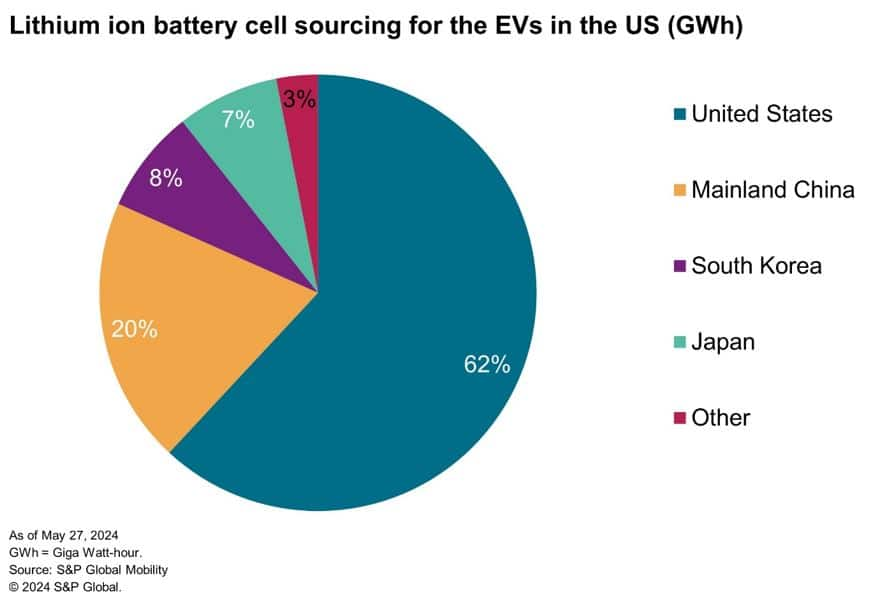
Currently, the US gets most of its lithium-ion batteries from
China, but only a small portion of these batteries are for use in
EVs. According to S&P Global Mobility's high-voltage battery
forecast, in 2024, based on GWh, about 62% of the lithium-ion
battery demand for EVs produced in the US will be met from plants
in the US. South Korea and Japan will account for approximately 8%
and 7%, respectively. Interestingly, around 20% of the overall
demand in the US will be sourced from plants in mainland China.
The current share of mainland China could grow significantly in
the future if EV companies in the US find importing from mainland
China as a much cheaper option than manufacturing or sourcing
batteries locally in the US, discouraging manufacturing of the
component in the US.
Actions, reactions and
implications
The latest change in tariff rates has come almost five months
after the US administration had recognized mainland China as a
foreign entity of concern (FEOC) to discourage EV companies from
sourcing batteries and raw materials from China-based suppliers.
Earlier in December 2023, mainland China had imposed an export
control measure on graphite, a critical raw material used in
batteries. The move to contain graphite exports was widely seen as
a countermeasure to respond to the US' export restriction for AI
chips and semiconductor manufacturing equipment to mainland
China.
According to Ali Adim, senior analyst at S&P Global
Mobility, “The import tariffs aim to protect the North American
battery supply chain from cheaper Chinese products, thereby
levelling the playing field for the growing domestic industry.
However, these tariffs may also hinder access to technologies such
as lithium iron phosphate (LFP), which offers a significant cost
advantage over nickel-based chemistries and is predominantly
produced in China. Additionally, the IRA disqualifies vehicles with
Chinese batteries from tax credits, creating another barrier to
adopting LFP technology.
Adim added, “Some American OEMs, like GM and Ford, are exploring
domestic LFP production through licensing agreements with Chinese
suppliers such as CATL. However, the cost benefits of local
production are uncertain due to the lack of an upstream supply
chain in North America.”
Rome was not built in a day
With the local content requirements under the IRA and the latest
tariff hikes, the US has dealt a double blow to lithium-ion battery
imports from mainland China, but it still relies on mainland China
directly and indirectly for a range of minerals, including cobalt,
graphite and lithium. Mainland China continues to dominate the EV
supply chain with more than 80% control on certain segments of the
supply chain, including mining and processing of critical minerals.
The US government has made progress on onshoring EV component
manufacturing, but it takes time for efficient supply chains to
form and any retaliatory measure from mainland China like
reciprocal tariffs or export restrictions on critical materials
could impact the US EV industry in the short term.
Hugo Enrique Cruz, senior analyst at S&P Global Mobility,
said, “When comparing the costs of raw materials and operational
expenses, it is found that the average price of high-energy NCM
lithium battery cells produced in the USA could be 30% higher than
the cost-effective LFP batteries manufactured in China. Chinese
manufacturers enjoy economies of scale in their factories and have
a more integrated supply chain within the country. On the other
hand, battery manufacturers in the US face higher costs due to
increased energy, labor and permitting expenses compared to their
Asian counterparts.”
Get daily insights and
intelligence by subscribing to AutoTechInsight.
Commercials Cooperation Advertisements:
(1) IT Teacher IT Freelance

立刻註冊及報名電腦補習課程吧!
电子计算机 -教育 -IT 電腦班” ( IT電腦補習 ) 提供一個方便的电子计算机 教育平台, 為大家配對信息技术, 電腦 老師, IT freelance 和 programming expert. 讓大家方便地就能找到合適的電腦補習, 電腦班, 家教, 私人老師.
We are a education and information platform which you can find a IT private tutorial teacher or freelance.
Also we provide different information about information technology, Computer, programming, mobile, Android, apple, game, movie, anime, animation…
(2) ITSec

www.ITSeceu.uk
Secure Your Computers from Cyber Threats and mitigate risks with professional services to defend Hackers.
ITSec provide IT Security and Compliance Services, including IT Compliance Services, Risk Assessment, IT Audit, Security Assessment and Audit, ISO 27001 Consulting and Certification, GDPR Compliance Services, Privacy Impact Assessment (PIA), Penetration test, Ethical Hacking, Vulnerabilities scan, IT Consulting, Data Privacy Consulting, Data Protection Services, Information Security Consulting, Cyber Security Consulting, Network Security Audit, Security Awareness Training.
Contact us right away.
Email (Prefer using email to contact us):
SalesExecutive@ITSec.vip